India has become an increasingly attractive manufacturing destination for brands looking to develop and produce cosmetics, fragrances, personal-care products and other consumer products for domestic and international markets.
For a global brand, choosing a manufacturing partner is about much more than finding a factory with production capacity. Brands need a partner who can understand their product concept, support formulation and packaging, maintain consistent quality and help coordinate the requirements involved in bringing a product to market.
Indian cosmetic manufacturers can provide this combination of product development, manufacturing expertise, flexible production and cost-efficient supply chains.
At Cosmella Infinity Private Limited, we work with brands looking for private-label and contract manufacturing solutions for fragrance, deodorant, perfume and aerosol-based products, supporting product development and manufacturing for both Indian and international markets.
Why Are Global Brands Looking at India for Cosmetic Manufacturing?
India has a large and established cosmetics and personal-care manufacturing ecosystem, supported by raw-material suppliers, packaging manufacturers, fragrance companies, technical professionals and manufacturing infrastructure.
For international brands, India can offer several potential advantages:
- Competitive manufacturing costs
- Established manufacturing capabilities
- Access to fragrance and cosmetic ingredients
- Wide packaging options
- Product-development capabilities
- Flexible private-label opportunities
- Growing export infrastructure
- Experience serving diverse consumer markets
However, cost alone should not be the primary reason for selecting a manufacturer.
The right manufacturing partner should also be evaluated based on quality, consistency, communication, documentation, scalability and ability to meet the requirements of the target market.
What Does Private Label Manufacturing Mean?
Private-label manufacturing allows a brand to sell a product under its own brand name while the manufacturing partner develops or produces the product.
Depending on the project, the manufacturer may support:
- Product concept development
- Fragrance selection or development
- Formulation
- Raw-material sourcing
- Packaging selection
- Product testing
- Filling
- Labelling
- Quality control
- Finished-product manufacturing
The brand maintains its own identity while the manufacturing partner provides the technical and production capabilities needed to manufacture the product.
For some brands, the manufacturer may provide an existing formulation that can be customized. For others, the project may involve developing a more customized product from the beginning.
How Indian Manufacturers Support Global Brands
A capable Indian cosmetic manufacturer can support an international brand through multiple stages of the product lifecycle.
1. Understanding the Brand's Product Concept
The process generally begins with a product brief.
An international brand may approach a manufacturer with a concept such as:
"We want to launch a premium men's fragrance and deodorant range for the Middle Eastern market."
The manufacturer then needs to understand the commercial and technical requirements behind that idea.
Important information may include:
- Target country
- Target consumer
- Product category
- Desired fragrance profile
- Product size
- Packaging preferences
- Target price
- Expected order quantity
- Product claims
- Launch timeline
- Regulatory requirements
A clear product brief creates a better foundation for development.
2. Fragrance Development and Selection
For perfume, deodorant and body-spray brands, fragrance is often one of the most important parts of the product.
Manufacturers may support brands with:
- Existing fragrance options
- Customized fragrance briefs
- Fragrance sampling
- Fragrance evaluation
- Product-specific fragrance development
A brand may provide a description of the desired fragrance rather than a complete formula.
For example:
- Fresh and citrus
- Warm and woody
- Floral and elegant
- Oriental and rich
- Clean and aquatic
- Premium and sophisticated
The fragrance team can then develop or recommend suitable options.
For fragrance products, applicable fragrance safety considerations should also be evaluated for the intended application and market.
The International Fragrance Association (IFRA) publishes Standards that establish rules for the use of certain fragrance materials, including prohibitions, restrictions and specifications. IFRA
Brands can also learn more through Cosmella's detailed article:
Understanding IFRA Compliance for Fragrance Manufacturing
3. Product Formulation
Fragrance is only one part of the final product.
The manufacturer must develop or select a formulation that delivers the required product performance.
Depending on the product, formulation may involve:
- Fragrance
- Alcohol
- Water
- Solvents
- Functional ingredients
- Deodorizing ingredients
- Emollients
- Propellants
- Other formulation components
The formulation needs to be suitable for the intended product, packaging and application.
For example, an aerosol deodorant requires a formulation compatible with its aerosol container, valve and propellant system.
A perfume requires a different formulation approach.
This is where technical manufacturing experience becomes particularly important.
4. Product Development for the Target Market
A product developed for India may not automatically be suitable for every international market.
Different countries can have different requirements concerning:
- Ingredients
- Product claims
- Labelling
- Safety information
- Fragrance ingredients
- Product documentation
- Packaging
- Import requirements
Therefore, international brands should communicate their target market to the manufacturer at the beginning of the project.
This allows the formulation, fragrance, packaging and documentation strategy to be evaluated with the destination market in mind.
5. Regulatory and Compliance Considerations
Cosmetic manufacturing involves regulatory requirements that vary according to the product and market.
For products manufactured in India, the applicable Indian regulatory framework should be considered.
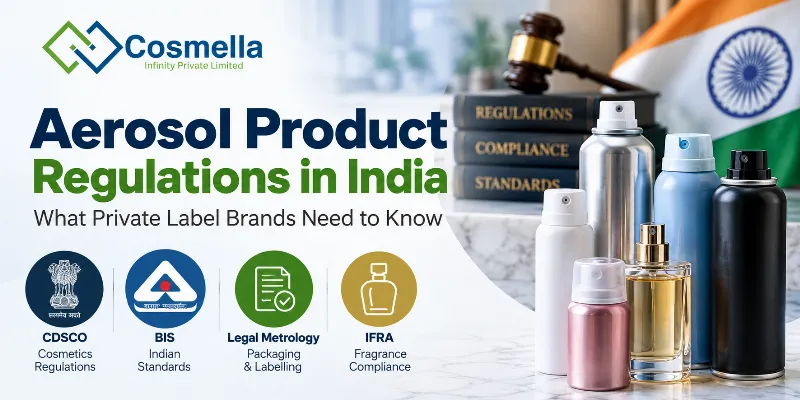
The Cosmetics Rules, 2020, published by India's Central Drugs Standard Control Organization (CDSCO), provide the regulatory framework for cosmetics covered by the rules. CDSCO
For international products, additional requirements of the destination country may apply.
A good manufacturing partner should therefore understand that Indian manufacturing compliance and destination-market compliance are related but not necessarily identical.
6. Packaging Development and Sourcing
Packaging plays two important roles:
Protecting the product and communicating the brand.
Indian manufacturers can support brands with packaging options such as:
- Perfume bottles
- Aerosol cans
- Pumps
- Valves
- Actuators
- Caps
- Labels
- Cartons
- Shrink packaging
- Secondary packaging
For premium brands, packaging may be a significant part of the product-development process.
For aerosol products, the packaging system also needs to be evaluated for compatibility with the formulation, filling process and storage conditions.
7. Supporting Private Label Branding
Global brands may already have their own visual identity, while others need support in developing a new product range.
A manufacturing project may involve:
Brand → Product Concept → Fragrance → Formula → Packaging → Artwork → Manufacturing → Finished Product
The manufacturing partner can coordinate these stages according to the agreed project scope.
This allows a brand to focus on its market, branding and distribution while the manufacturing partner handles the technical and production side.
8. Quality Control and Batch Consistency
For an international brand, consistency is critical.
A product that performs differently from one production batch to another can negatively affect customer experience and brand reputation.
Quality-control processes may include checks relating to:
- Raw materials
- Fragrance characteristics
- Product appearance
- Product consistency
- Fill quantity
- Packaging
- Spray performance
- Leakage
- Stability
- Finished-product specifications
The exact quality-control process depends on the product.
The objective is to ensure that commercial production remains consistent with the approved product specifications.
9. Documentation and Traceability
International buyers often need more than finished products.
They may also require appropriate product and manufacturing documentation.
Depending on the product and destination market, documentation may include:
- Product specifications
- Ingredient information
- Raw-material documentation
- Fragrance documentation
- Safety Data Sheets (SDS), where applicable
- Test reports
- Batch records
- Quality-control records
- Packaging specifications
- Product artwork
- Compliance documentation
Good documentation also helps brands manage repeat orders and future product development.
10. Indian Standards and Product Requirements
Where applicable, Indian Standards may form part of the manufacturing and quality framework.
The Bureau of Indian Standards (BIS) provides a "Know Your Standard" portal where users can search Indian Standards using an IS number or product keyword. BIS
BIS also explains that where a certification licence is applicable, manufacturers need to establish appropriate manufacturing infrastructure, process controls, quality-control and testing capabilities for the relevant standard. BIS
Importantly, not every cosmetic or aerosol product should automatically be described as requiring BIS certification. The applicable requirements depend on the specific product and relevant standards.
11. Labelling and Packaging Requirements
For products sold in India, applicable packaging and labelling requirements need to be considered.
The Department of Consumer Affairs administers the Legal Metrology framework, including the Legal Metrology (Packaged Commodities) Rules, 2011.
Depending on the product and packaging, declarations can include information such as:
- Manufacturer or packer details
- Product name
- Net quantity
- MRP
- Country of origin, where applicable
- Consumer-care information
- Other mandatory declarations
The exact requirements depend on the product and applicable rules.
Department of Consumer Affairs – Legal Metrology
For export products, the destination country's labelling requirements also need to be considered.
12. Manufacturing at Different Production Scales
One of the advantages of working with an experienced manufacturer is the ability to develop a product with future growth in mind.
A brand may initially require:
Small development batch → Initial commercial batch → Larger repeat production → Scaled manufacturing
The manufacturing strategy can be planned around expected demand, packaging availability, raw-material sourcing and production capacity.
This can be particularly useful for startups that want to test a product before committing to larger volumes.
13. Supporting International Export Orders
When an Indian manufacturer supplies products to an international brand, export logistics become part of the overall supply chain.
Depending on the arrangement, the parties may need to coordinate:
- Product specifications
- Commercial documentation
- Packaging
- Shipping requirements
- Export documentation
- Destination-market requirements
- Product classification
- Transportation considerations
For businesses exporting from India, the Directorate General of Foreign Trade (DGFT) provides the regulatory framework and online services relating to Importer-Exporter Code (IEC) and foreign trade procedures. DGFT states that an IEC is generally required for undertaking export/import activities, subject to applicable exemptions. DGFT
DGFT – Directorate General of Foreign Trade
The exact export responsibilities depend on whether the manufacturer, brand owner, distributor or another party is acting as the exporter.
14. Why Communication Matters in International Manufacturing
One of the less obvious challenges in private-label manufacturing is communication.
A global brand may be located thousands of kilometres away from the manufacturing facility.
Clear communication is therefore essential for:
- Product specifications
- Sample approval
- Fragrance selection
- Packaging approval
- Artwork
- Production schedules
- Quality expectations
- Documentation
- Shipment planning
A professional manufacturer should be able to communicate clearly throughout the development and production process.
15. India as a Manufacturing Partner, Not Just a Supplier
For global brands, there is an important distinction between finding a supplier and finding a manufacturing partner.
A supplier may primarily provide a finished product or component.
A manufacturing partner can potentially become involved much earlier:
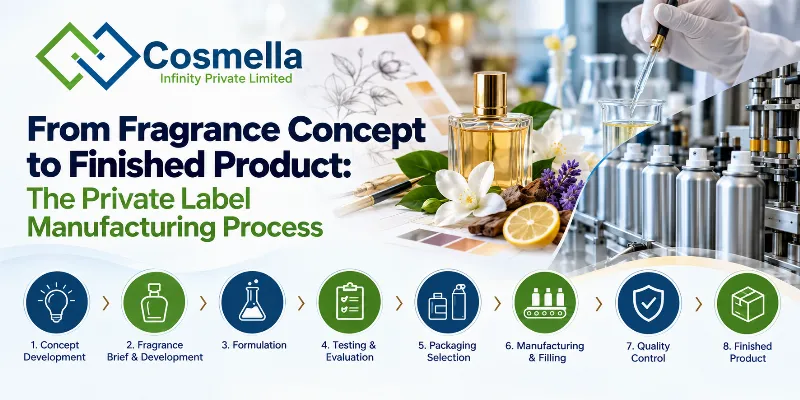
Concept → Development → Formulation → Fragrance → Packaging → Testing → Manufacturing → Quality Control → Supply
This deeper involvement can be particularly valuable for brands developing new products or entering new markets.
What Global Brands Should Look for in an Indian Cosmetic Manufacturer
Before selecting a manufacturing partner, international brands should evaluate:
Manufacturing capabilities
Does the manufacturer have experience with the specific product category?
Product development
Can the manufacturer support formulation and fragrance development?
Quality systems
How are raw materials, production batches and finished products evaluated?
Packaging capabilities
Can the manufacturer support the required packaging components?
Documentation
Can the manufacturer provide appropriate product and batch documentation?
Scalability
Can the manufacturer support increasing production volumes?
Export experience
Does the manufacturer understand the practical requirements involved in international orders?
Communication
Can the manufacturer provide clear and consistent communication throughout development and production?
Compliance awareness
Does the manufacturer understand that requirements vary according to product category and destination market?
Why Global Brands Choose Indian Manufacturing
India can provide global brands with access to a broad manufacturing ecosystem and competitive production capabilities.
However, the real value of an Indian manufacturing partner is not simply the ability to produce a product at a competitive price.
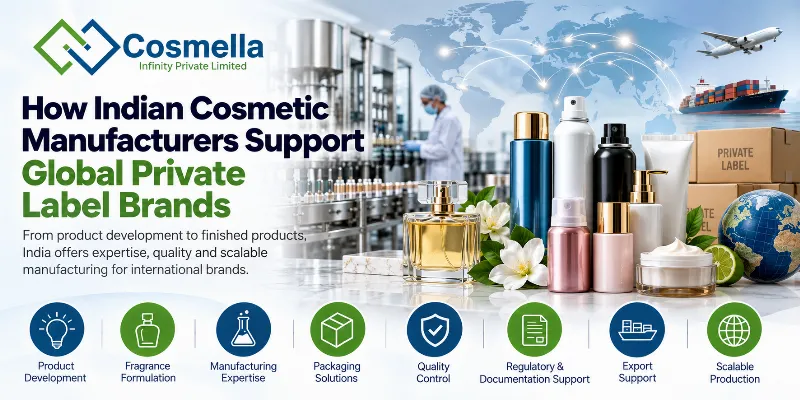
A strong partnership can provide:
- Product-development support
- Manufacturing expertise
- Fragrance development
- Packaging coordination
- Quality control
- Documentation
- Production scalability
- Export-oriented manufacturing support
For a brand entering the market with a new product, having these capabilities connected through one manufacturing relationship can simplify the development process.
How Cosmella Supports Global Private Label Brands
At Cosmella Infinity Private Limited, we work with brands seeking private-label and contract manufacturing solutions for fragrance and aerosol-based products.
Our approach can support the journey from:
Product Concept → Fragrance → Formulation → Packaging → Testing → Manufacturing → Quality Control → Finished Product
Our manufacturing capabilities include products such as:
- Perfumes
- Deodorants
- Body sprays
- Fragrance products
- Aerosol products
- Other private-label personal-care products
We support brands targeting both domestic and international markets, with product development and manufacturing requirements considered according to the intended market.
Whether you are an established international brand expanding your product portfolio or a startup developing your first fragrance product, the manufacturing process can be structured around your brand requirements, target market and expected production volumes.
Frequently Asked Questions
Why do global brands choose Indian cosmetic manufacturers?
India offers an established manufacturing ecosystem, competitive production capabilities, access to raw materials and packaging suppliers, and experience across cosmetics, fragrances and personal-care products.
However, brands should evaluate individual manufacturers based on quality, capabilities, documentation, compliance and communication rather than choosing solely on price.
Can an Indian manufacturer produce cosmetics for international brands?
Yes. Indian manufacturers can produce products for international brands, subject to the applicable manufacturing, product and destination-market requirements.
Can a global brand create a customized fragrance in India?
Yes. Depending on the manufacturer's capabilities, brands can develop customized fragrances based on a fragrance brief and target-market requirements.
Can Indian manufacturers handle private-label packaging?
Many manufacturers can coordinate or support packaging requirements, including bottles, aerosol cans, pumps, valves, labels, cartons and other packaging components. The available options depend on the manufacturer and product.
Does a product manufactured in India automatically comply with European or US regulations?
No. Manufacturing in India does not automatically mean that a product meets the requirements of another country. Destination-market regulations should be evaluated separately.
Can Indian manufacturers support small brands and startups?
Some manufacturers offer development and production options suitable for smaller brands, although minimum order quantities and development conditions vary between manufacturers.
What documents should an international brand request from a manufacturer?
Depending on the product and market, brands may require product specifications, ingredient information, fragrance documentation, test reports, SDS where applicable, batch records, quality documentation and other compliance-related information.
Is India suitable for export-oriented perfume and deodorant manufacturing?
India can be a suitable manufacturing base for export-oriented fragrance and personal-care products, provided the manufacturer and product are appropriately prepared for the requirements of the intended destination market.
Official and Industry Resources
Brands researching Indian cosmetic manufacturing and international product development may find these official resources useful:
- CDSCO – Cosmetics Rules, 2020
- CDSCO – Cosmetics Regulatory Information
- BIS – Know Your Standard
- Department of Consumer Affairs – Legal Metrology
- DGFT – Directorate General of Foreign Trade
- IFRA – Understanding the IFRA Standards
Conclusion
For global brands, choosing an Indian cosmetic manufacturer can provide access to manufacturing expertise, product development capabilities, packaging options and scalable production.
But successful international private-label manufacturing depends on more than production capacity.
The right partner should understand the entire journey—from product concept and fragrance development to formulation, packaging, quality control, documentation and manufacturing—while keeping the intended destination market in consideration.
For brands looking for an Indian partner for private-label perfume, deodorant, fragrance and aerosol manufacturing, Cosmella Infinity Private Limited provides a manufacturing-focused approach designed to support both domestic and international brands.
Looking for a private-label cosmetic manufacturer in India?
Connect with Cosmella Infinity Private Limited to discuss your product concept, fragrance, packaging and manufacturing requirements.
Disclaimer
Regulatory and export requirements can vary according to the product category, formulation, claims, packaging, country of destination and applicable laws. This article is provided for general informational purposes and should not be considered legal, regulatory or professional advice. Brands should verify the requirements applicable to their specific products with the relevant authorities and qualified professionals before commercialization.
Have a query?