Introduction
A memorable fragrance can become one of the most distinctive elements of a perfume brand. It can evoke emotions, create lasting impressions and help customers recognise a brand through scent alone.
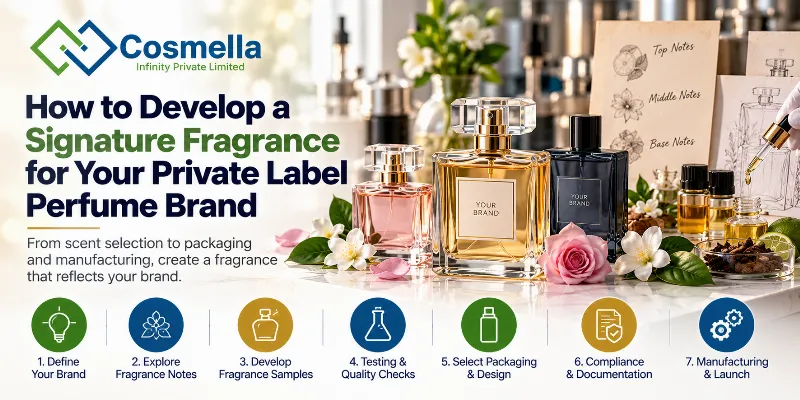
For entrepreneurs, retailers and established businesses planning to launch a perfume line, developing a signature fragrance involves more than choosing a pleasant smell. It requires a clear brand concept, an understanding of the target audience, careful fragrance selection, product testing, suitable packaging and a reliable manufacturing partner.
With the right approach to private label perfume manufacturing, businesses can transform an initial fragrance idea into a finished product that reflects their brand identity.
In this guide, we explain the key steps involved in developing a signature fragrance for your private label perfume brand.
1. Define Your Brand Identity and Target Audience
Before selecting a fragrance, define what your brand represents and whom you want to reach. A scent designed for a premium luxury brand may differ significantly from one developed for a youthful, everyday fragrance range.
Start by considering the following questions:
Who are your customers? Identify their age group, preferences, lifestyle and purchasing behaviour.
What should your brand communicate? Your fragrance may represent elegance, freshness, confidence, energy, sophistication or relaxation.
What is your price positioning? Your target retail price will influence fragrance selection, packaging and manufacturing choices.
Where will you sell? Online stores, retail outlets, gifting channels and export markets may have different customer expectations.
For example, a contemporary fragrance brand might focus on fresh citrus and aquatic notes, while a premium evening fragrance could explore warm woods, amber and richer floral accords.
A clear brand identity provides a foundation for every decision that follows.
2. Understand Fragrance Notes and Scent Families
Perfumes are created by combining fragrance materials to produce a balanced and distinctive scent. Understanding fragrance notes helps you communicate your preferences to a fragrance development team.
Top Notes
Top notes create the initial impression when a perfume is applied. They are often fresh, light and noticeable during the opening stage.
Common examples include citrus, bergamot, lemon and selected aromatic notes.
Middle Notes
Middle notes, also known as heart notes, help define the main character of the fragrance as the initial notes begin to fade.
Floral, fruity, spicy and aromatic accords are frequently used to create this central character.
Base Notes
Base notes contribute depth and help shape the fragrance's later development on the skin. Common examples include woody, musky, amber and vanilla notes.
The way these elements work together influences the fragrance's overall character and development over time.
Popular Fragrance Families
| Fragrance family | Typical character |
|---|---|
| Citrus | Fresh, bright and energetic |
| Floral | Soft, romantic and elegant |
| Woody | Warm, refined and sophisticated |
| Oriental or amber | Rich, warm and expressive |
| Aquatic | Clean, airy and refreshing |
| Fruity | Sweet, lively and contemporary |
| Aromatic | Herbal, fresh and distinctive |
These families are useful starting points rather than strict rules. A signature fragrance may combine several families to create a more individual scent profile.
3. Choose the Right Fragrance Direction
Once your brand positioning is clear, decide on the overall scent direction you want to explore.
You might choose a fresh everyday fragrance, a floral signature scent, a woody premium perfume or a warm fragrance intended for evening wear.
You should also consider whether the fragrance will be marketed as men's, women's, unisex or part of a broader fragrance collection. These are branding decisions, and the final scent profile should reflect your customers' preferences rather than relying only on conventional categories.
When working with a fragrance manufacturer, prepare a brief that includes:
Your preferred fragrance family and scent characteristics.
Examples of fragrance styles you appreciate, described for reference rather than copying.
Your target customer and brand positioning.
The intended product format, such as perfume spray or pocket perfume.
Your expected price range and target market.
A clear brief helps the development team understand your vision and recommend suitable fragrance directions.
4. Work with a Private Label Perfume Manufacturer
A private label perfume manufacturer can help turn a brand concept into a market-ready fragrance product. Depending on the manufacturer's capabilities and the agreed project scope, this may include fragrance selection, product formulation, packaging coordination and manufacturing.
The process generally involves the following stages:
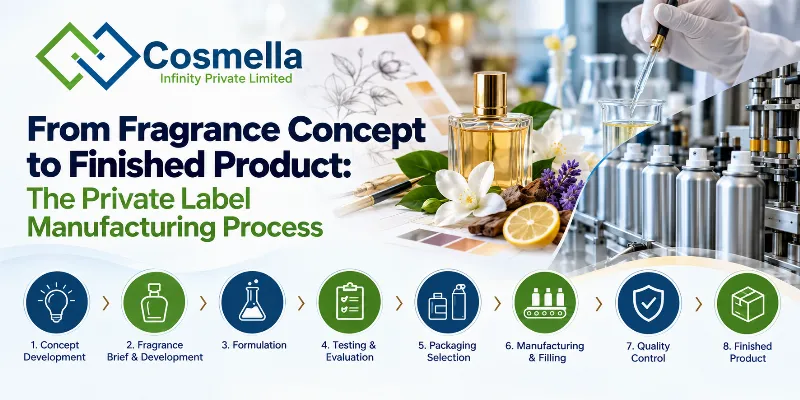
Concept discussion: You share your brand identity, target audience, desired fragrance profile and commercial requirements.
Fragrance selection: Suitable fragrance options are identified for evaluation against your brief.
Sample evaluation: You assess samples and provide feedback on the scent, its character and its suitability for your brand.
Refinement: Where available and agreed, the fragrance direction is adjusted through further sampling until the intended profile is achieved.
Product planning: The selected fragrance is matched with an appropriate product format, packaging concept and production specification.
Manufacturing: The approved product is produced according to the agreed specifications and applicable requirements.
Working with an experienced manufacturing partner can help streamline coordination between fragrance development, packaging and production.
For businesses exploring manufacturing options, visit Cosmella to learn more about its private label and contract manufacturing services.
5. Evaluate Samples Before Finalising Your Fragrance
A fragrance that smells appealing immediately after application may develop differently over time. Sample evaluation is therefore an important part of selecting a signature scent.
When reviewing samples, consider the following:
Opening impression: Does the fragrance create the intended first impression?
Scent development: How does the fragrance change as time passes?
Overall balance: Are the different notes harmonious, or does one element dominate?
Brand suitability: Does the scent match the personality and positioning of your brand?
Target audience feedback: Do representative customers respond positively to the fragrance?
Consistency: Does the selected fragrance meet the agreed sensory expectations across evaluation samples?
Where appropriate, evaluate samples on suitable testing materials and on skin, following relevant safety instructions. Keep records of sample references, feedback and approval decisions.
Do not rely on a single person's preference alone. Feedback from a representative group of target customers can help you make a more informed commercial decision.
6. Consider Fragrance Concentration and Product Format
A perfume's performance depends on several factors, including its formulation, fragrance materials, concentration, application method and the conditions in which it is used.
Common fragrance product formats include:
Eau de Parfum (EDP): A fragrance format often positioned for a more concentrated perfume experience.
Eau de Toilette (EDT): A commonly used format with its own concentration and performance profile.
Perfume sprays: Products developed for convenient application in different fragrance categories.
Pocket perfumes: Compact formats designed for portability and everyday convenience.
EDP and EDT are widely used market terms, but their concentration ranges and performance are not universal guarantees. Actual characteristics depend on the formulation and the finished product.
The right format should align with your brand concept, target price, customer expectations and packaging requirements.
A manufacturer can help evaluate which product format is appropriate for your project and intended market.
7. Select Packaging That Reflects Your Brand
Packaging is an important part of the customer's first impression. It communicates the product's positioning before the customer experiences the fragrance itself.
When planning packaging, consider:
Bottle design: Choose a shape, size and finish that complement your brand identity.
Spray mechanism: The sprayer should deliver a suitable and consistent application for the intended product.
Materials and compatibility: The bottle, closure, seals and other packaging components should be suitable for the formulation and intended storage conditions.
Label design: Use clear product identification and the information required for the markets in which the perfume will be sold.
Secondary packaging: Boxes, sleeves and inserts can support premium presentation, gifting and retail display.
Practicality: Consider transport, storage, handling, leakage prevention and the overall cost of packaging.
For a new brand, it may be useful to begin with a suitable existing bottle design and distinctive branding. Custom bottle development can be explored when the budget, production volume and brand strategy justify the additional investment.
8. Prioritise Quality, Stability and Fragrance Safety
A signature fragrance must be suitable not only in terms of scent but also in terms of the finished product's quality and intended use.
Before commercial production, discuss the relevant testing and documentation requirements with your manufacturing partner.
Depending on the formulation and product format, these may include:
Fragrance and finished-product specifications.
Stability evaluation under appropriate conditions.
Packaging compatibility checks.
Quality-control procedures and batch consistency.
Microbiological testing, where relevant to the product.
Applicable safety documentation and regulatory review.
The International Fragrance Association (IFRA) publishes fragrance standards that restrict, prohibit or set specifications for certain fragrance materials based on scientific safety assessments. The relevant requirements depend on the intended application and product category.
An IFRA Certificate of Conformity, where applicable, is prepared by the supplier of the fragrance mixture; it is not issued by IFRA itself. Such a certificate does not replace a safety assessment or compliance with applicable laws.
For further reading, see Cosmella's article on IFRA and fragrance manufacturing.
9. Check Regulatory Requirements for Your Target Market
Regulatory requirements should be considered early, especially if you intend to sell in multiple countries.
For products marketed in India, the applicable requirements may include provisions under the Cosmetics Rules, 2020, along with relevant manufacturing, labelling, quality and packaging requirements. The exact obligations depend on the product classification and circumstances.
For export markets, additional requirements may apply. These can differ by destination and may concern ingredient restrictions, product documentation, labels, safety assessments and responsible parties.
Before finalising your product, confirm the applicable requirements for each intended market with qualified regulatory professionals and your manufacturing partner.
Do not assume that meeting one voluntary industry standard automatically satisfies every legal requirement in India or overseas.
10. Plan Commercial Production and Launch
Once the fragrance, packaging and product specifications have been approved, prepare for production and launch.
Discuss these commercial factors with your manufacturing partner:
Minimum order quantity (MOQ).
Sample and development costs.
Fragrance and packaging availability.
Production lead times.
Quality specifications and batch approval.
Packaging artwork and label approval.
Storage, shipping and export requirements, where applicable.
It is also useful to plan how your fragrance will be introduced to customers. Product photography, fragrance descriptions, sampling initiatives, retail presentation and online product pages can all help communicate the product's identity.
Describe the fragrance clearly and accurately. Avoid unsupported claims about longevity, safety, ingredients or performance.
A structured launch plan can help reduce avoidable delays and keep the product aligned with your original brand concept.
Common Mistakes to Avoid When Developing a Signature Fragrance
Several mistakes can make fragrance development more difficult or increase costs.
Choosing a scent without defining the target customer: A fragrance should support a clear brand and customer proposition.
Making decisions based only on the first impression: Evaluate how the scent develops over time before approving it.
Ignoring packaging compatibility: Packaging should be assessed alongside the formulation, not treated as a purely visual decision.
Overlooking compliance until the end: Regulatory and documentation requirements should be considered early in development.
Underestimating production costs: Fragrance, packaging, artwork, testing and manufacturing all contribute to the final product cost.
Expecting a fragrance to remain identical in every environment: Storage conditions, application method and individual perception can influence the experience. Set realistic product expectations.
Avoiding these mistakes can make the development process more organised and commercially focused.
Why Choose Cosmella for Private Label Fragrance Manufacturing?
Developing a perfume brand requires coordination between the fragrance concept, product format, packaging and manufacturing process. Choosing a manufacturing partner that understands these requirements can help businesses move from an initial idea towards a finished product.
Cosmella Infinity Private Limited supports businesses exploring cosmetic and personal-care manufacturing solutions for their brands. Whether you are planning a new fragrance range or expanding an existing product portfolio, discuss your product concept, target market, packaging preferences and production requirements with the Cosmella team.
A clearly defined project brief can help establish the next steps for evaluating suitable product and manufacturing options.
Conclusion
Developing a signature fragrance is a structured process that brings together creativity, customer understanding, fragrance evaluation, packaging, quality and regulatory planning.
Start with a clear brand identity, define the scent direction you want to explore, evaluate samples carefully and select a manufacturing partner who can help coordinate the product development process.
With thoughtful planning, your fragrance concept can become a distinctive product that fits your brand's positioning and appeals to your intended customers.
Planning to launch your own perfume brand? Visit Cosmella to discuss private label and contract manufacturing possibilities for your fragrance product range.
Frequently Asked Questions
1. What is a signature fragrance?
A signature fragrance is a scent selected or developed to represent a brand or product line. It should reflect the brand's identity and create a recognisable experience for its intended customers.
2. Can I create my own perfume brand without owning a factory?
Yes. Depending on the manufacturer's services and the applicable requirements, a business can work with a private label or contract manufacturer to develop and produce perfume products under its own brand.
3. How long does it take to develop a private label perfume?
The timeline depends on fragrance selection, sample revisions, packaging availability, testing, documentation and production scheduling. Ask your manufacturer for a project-specific timeline before confirming launch dates.
4. Can I choose my own perfume bottle and packaging?
Packaging options depend on availability, order quantity, budget and compatibility with the finished formulation. Discuss standard and custom packaging options during the planning stage.
5. What is the role of IFRA standards in perfume development?
IFRA standards provide guidance and restrictions for the use of certain fragrance materials in intended product applications. Relevant requirements should be reviewed for the specific fragrance and product category. They do not replace applicable legal requirements or a complete product safety assessment.
6. What information should I share with a private label perfume manufacturer?
Prepare your brand concept, target audience, preferred fragrance family, product format, expected retail price, packaging preferences, target markets and estimated order quantity. This information helps the manufacturer assess your requirements and recommend suitable next steps.
Have a query?