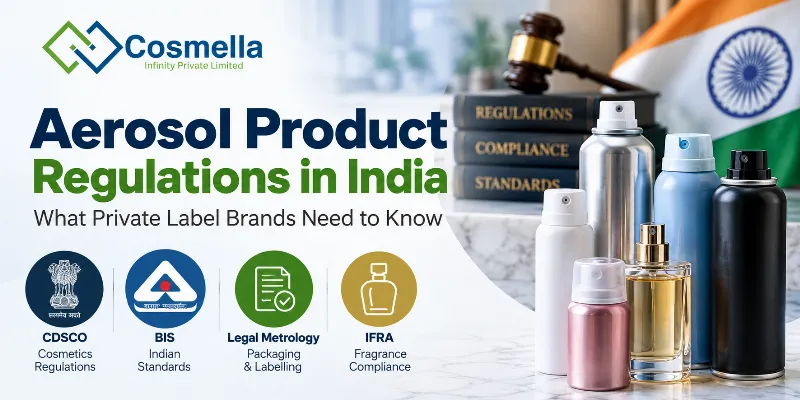
Aerosol Product Regulations in India: What Private Label Brands Need to Know
Aerosol products have become an important part of the personal care, fragrance, home care and FMCG industries. Products such as deodorants, body sprays, perfumes, air fresheners and other spray-based products are widely used across India.
For brands planning to launch an aerosol product through private label or contract manufacturing, understanding the applicable regulatory and quality requirements is essential. Compliance is not limited to the formulation alone. It can also involve product classification, packaging, labelling, manufacturing, fragrance ingredients, product claims and quality control.
At Cosmella Infinity Private Limited, we support brands with private-label and contract manufacturing solutions for aerosol-based products, with a focus on quality, compliance and scalable production for both domestic and international markets.
What Are Aerosol Products?
An aerosol product is generally packaged in a pressurised container that releases the product in the form of a spray, mist, foam or other controlled discharge when the valve is activated.
Common examples include:
Aerosol deodorants
Body sprays
Perfume sprays
Fragrance products
Air fresheners
Personal care sprays
Certain home-care and industrial spray products
The applicable regulatory requirements can vary depending on the product category, formulation, intended use, claims and packaging system.
Therefore, a private-label brand should determine the regulatory classification of its product before starting commercial production.
Why Regulatory Compliance Matters for Private Label Brands
Launching a private-label product involves more than creating an attractive fragrance and packaging design.
A product placed on the Indian market should comply with the requirements applicable to its category. Non-compliance can create problems involving product labelling, manufacturing, quality, consumer safety and marketability.
Regulatory planning can help brands to:
Reduce the risk of compliance issues
Select appropriate ingredients and formulations
Develop appropriate product labels
Choose suitable packaging components
Establish quality-control procedures
Prepare required product documentation
Support smoother product launches
Build customer and distributor confidence
Working with an experienced contract manufacturer can help brands address these considerations during product development rather than after production has started.
1. Identify the Correct Product Category
The first step is to understand what the product actually is and how it will be marketed.
For example, an aerosol deodorant intended for personal care may fall within the cosmetics regulatory framework, while an air freshener or another non-cosmetic aerosol may be subject to a different regulatory framework.
Product classification can depend on factors such as:
Intended use
Product formulation
Ingredients
Product claims
Target consumer
Mode of application
Packaging and dispensing system
This is why regulatory assessment should be carried out at the product-development stage.
2. Cosmetics Regulations for Personal Care Aerosols
Aerosol deodorants, body sprays and certain fragrance products may fall within the scope of India's cosmetics regulatory framework depending on their intended use and formulation.
Brands should consider the applicable requirements under the Drugs and Cosmetics Act, 1940 and the Cosmetics Rules, 2020, where applicable.
The Central Drugs Standard Control Organization (CDSCO) provides the official Cosmetics Rules, 2020 and regulatory information relating to cosmetics in India.
For reference, brands can review the official:
The requirements can cover areas such as:
Product safety
Ingredients
Manufacturing
Labelling
Product standards
Manufacturing premises
Quality control
Documentation
The exact requirements should be evaluated according to the specific product.
3. BIS Standards and Applicable Product Requirements
The Bureau of Indian Standards (BIS) develops Indian Standards covering a wide range of products, materials and processes.
For aerosol products, the applicable Indian Standard depends on the specific product and its category. Therefore, brands should not assume that every aerosol product requires the same BIS certification or follows the same standard.
BIS provides its Know Your Standard facility, which allows users to search for Indian Standards using an IS number or a keyword such as a product name. The portal can also provide access to related standards, amendments, gazette notifications, testing information and other standard-related details.
Brands can check the official BIS resource here:
Where a particular product or component is covered by a mandatory requirement, the applicable standard and conformity requirements should be addressed before commercialization.
4. Legal Metrology and Product Labelling
Labelling is an important part of launching a packaged product in India.
Depending on the product category and packaging, applicable requirements under the Legal Metrology (Packaged Commodities) Rules, 2011 should also be considered.
The Department of Consumer Affairs publishes information and notifications relating to Legal Metrology and packaged commodities. Requirements can include declarations concerning matters such as manufacturer or packer information, net quantity, MRP and consumer-care details, subject to the applicable rules and exemptions.
Brands should therefore review the latest requirements before finalising packaging artwork.
Department of Consumer Affairs – Legal Metrology
For private-label products, it is particularly important to determine who is identified as the manufacturer, packer, marketer or brand owner, as applicable, and how these details should appear on the final packaging.
5. Ingredient and Formulation Compliance
The formulation is another important part of regulatory planning.
Before commercial production, manufacturers and brands should evaluate the ingredients used in the product and their intended concentration and function.
For fragrance-based products, considerations may include:
Fragrance composition
Restricted or prohibited ingredients
Ingredient specifications
Product stability
Compatibility with packaging
Safety considerations
Applicable cosmetic requirements
For fragrance products, IFRA Standards can also be an important consideration.
According to IFRA, its Standards establish rules for the use of a range of fragrance materials, including prohibitions, restrictions and specifications.
IFRA – Understanding the IFRA Standards
Cosmella has also covered this subject in more detail in:
Understanding IFRA Compliance for Fragrance Manufacturing
IFRA compliance is particularly relevant when developing fragrance products intended for different applications and markets.
6. Aerosol Can and Packaging Safety
Unlike conventional bottles or tubes, aerosol products are stored under pressure.
Therefore, packaging selection is an important part of product development.
An aerosol system may include:
Aerosol can
Valve
Actuator
Dip tube
Propellant
Product concentrate
Overcap
The components need to be suitable for the intended formulation and filling process.
Important considerations can include:
Container compatibility
Internal pressure
Valve compatibility
Product leakage
Corrosion resistance
Spray performance
Filling accuracy
Storage stability
Transportation conditions
The packaging system should be evaluated as part of the complete product rather than treating the aerosol can as a separate component.
7. Propellant Selection
Propellant selection can influence the performance and characteristics of an aerosol product.
Depending on the product and formulation, manufacturers may evaluate different propellant systems based on factors such as:
Spray characteristics
Pressure
Product compatibility
Filling requirements
Storage conditions
Safety considerations
Regulatory considerations
Intended market
The appropriate propellant should be selected according to the product formulation, packaging system and intended application.
8. Product Testing and Quality Control
Regulatory compliance is only one part of producing a reliable aerosol product.
Quality control is also important to ensure consistency from batch to batch.
Depending on the product, testing and quality checks may include:
Appearance
Fragrance characteristics
Net fill
Spray performance
Container compatibility
Leakage checks
Pressure-related checks
Stability evaluation
Packaging integrity
Batch consistency
A structured quality-control process helps brands maintain consistent product performance as production volumes increase.
9. Product Claims Should Be Carefully Evaluated
Private-label brands often want their products to stand out through marketing claims.
However, claims should be appropriate for the product and supported by suitable evidence where required.
Examples of claims that may require careful evaluation include:
Long-lasting fragrance
24-hour protection
Dermatologically tested
Alcohol-free
Natural
Vegan
Hypoallergenic
Skin-friendly
Antibacterial
Odour protection
Claims should be evaluated before finalising packaging artwork because certain claims may require supporting evidence or may affect the regulatory assessment of a product.
The Cosmetics Rules, 2020 also address misleading claims for cosmetics.
10. Documentation for Private Label Aerosol Products
A private-label brand should maintain appropriate documentation throughout product development and manufacturing.
Depending on the product, documentation may include:
Product formulation information
Raw material specifications
Ingredient information
Fragrance documentation
Safety Data Sheets (SDS), where applicable
Product specifications
Batch manufacturing records
Quality-control records
Packaging specifications
Test reports
Stability information
Labelling and artwork
Applicable compliance documentation
The exact documentation required will depend on the product, market and regulatory framework.
Good documentation also makes it easier to manage future production batches and export requirements.
11. Domestic vs Export Compliance
One important point for private-label brands is that compliance requirements can differ between India and international markets.
A product that is suitable for the Indian market may require additional evaluation before being sold in another country.
Export markets may have requirements relating to:
Cosmetic regulations
Ingredient restrictions
Product information
Safety documentation
Product claims
Labelling
Fragrance compliance
Packaging
Import requirements
For example, brands exporting fragrance and cosmetic products may need to consider the regulatory requirements applicable in the European Union, United Kingdom, United States and other destination markets.
Therefore, it is better to consider the target export market during product development rather than modifying the product after manufacturing.
12. What Private Label Brands Should Ask an Aerosol Manufacturer
Before selecting a manufacturing partner, brands should ask questions such as:
What types of aerosol products do you manufacture?
Can you support formulation development?
Can you manufacture according to private-label requirements?
What aerosol packaging options are available?
How do you manage quality control?
Can you support fragrance development?
How do you handle regulatory documentation?
Can you support domestic as well as export products?
What are the minimum order quantities?
Can you support pilot or development batches?
What is the expected production lead time?
Can you support packaging and filling?
How are batch records and quality documentation maintained?
Choosing the right manufacturing partner at the beginning can help reduce development delays and avoid expensive changes later.
13. Why Work With an Experienced Aerosol Manufacturer?
Aerosol manufacturing combines formulation, packaging, filling, quality control and regulatory considerations.
For a brand entering the market for the first time, managing all these areas independently can be challenging.
An experienced contract manufacturer can help coordinate different stages of the process, including:
Product Concept → Formulation → Fragrance → Packaging → Testing → Filling → Quality Control → Finished Product
This integrated approach can help brands move from an initial product idea to commercial production more efficiently.
14. Building an Aerosol Product for Export Markets
If your long-term objective is international expansion, it is beneficial to consider export requirements from the beginning.
A formulation, fragrance, packaging system and label should ideally be developed with the intended destination market in mind.
For export-focused brands, important considerations may include:
Target-country regulations
Ingredient restrictions
Fragrance compliance
Product claims
Packaging requirements
Labelling requirements
Safety documentation
Product testing
Shipping and transportation requirements
Early planning can help reduce the possibility of reformulation or repackaging when entering a new market.
Choosing the Right Manufacturing Partner
Regulatory compliance should not be treated as the final step before launching an aerosol product.
It should be considered throughout the product-development process—from formulation and fragrance selection to packaging, filling, labelling and quality control.
For brands looking for private-label or contract aerosol manufacturing in India, Cosmella Infinity Private Limited provides manufacturing solutions designed to support brands from product development through finished-product production.
Our capabilities include aerosol-based products for personal care, fragrance and other applications, with manufacturing support for both domestic and export-oriented brands.
Frequently Asked Questions
Are all aerosol products regulated in the same way in India?
No. Requirements can vary depending on the product category, formulation, intended use, claims and packaging. A cosmetic deodorant, perfume aerosol and air freshener may be subject to different regulatory considerations.
Does every aerosol product require BIS certification?
Not necessarily. BIS requirements depend on the specific product, applicable Indian Standards and whether a particular requirement is mandatory for that product. The applicable standards should be determined based on the product category.
Do aerosol deodorants come under cosmetic regulations?
Aerosol deodorants intended for personal care may fall under India's cosmetics regulatory framework, subject to the applicable definition and requirements. The specific product should be assessed based on its formulation, intended use and claims.
Is IFRA compliance required for perfume and fragrance products?
IFRA Standards are an important consideration for fragrance safety and responsible fragrance use. The applicable requirements depend on the fragrance application and target market. Brands should work with their fragrance and manufacturing partners to ensure appropriate compliance.
What information should be included on an aerosol product label?
The required information depends on the product category and applicable regulations. It may include product details, net quantity, manufacturer or brand-owner information, batch information, MRP where applicable, usage instructions, warnings and other mandatory declarations.
Can an Indian manufacturer produce aerosol products for export?
Yes. Indian manufacturers can manufacture products for export markets, but the product should be developed and documented according to the requirements of the destination market.
What should I consider before launching a private-label aerosol product?
Start by defining the product category, target market, formulation, fragrance, packaging, claims, required documentation, compliance requirements, MOQ and production requirements. Early planning can make the transition from product concept to commercial production much smoother.
Official Regulatory Resources
For the latest requirements, brands should refer to the relevant official authorities and applicable legislation:
Conclusion
Launching a private-label aerosol product requires more than selecting a fragrance and designing a can. Product classification, formulation, packaging, labelling, quality control and applicable regulatory requirements all need to be considered before commercial production.
For brands targeting the Indian market, understanding the applicable Indian requirements is essential. For brands planning to export, destination-market requirements should be incorporated into the product-development process from the beginning.
By working with an experienced aerosol contract and private-label manufacturer, brands can bring together formulation, fragrance, packaging, filling and quality-control requirements under one manufacturing process.
Looking to develop a private-label aerosol product?
Connect with Cosmella Infinity Private Limited to discuss your product concept, formulation, packaging and manufacturing requirements for the Indian or international market.
Disclaimer
Regulatory requirements can vary depending on the product category, formulation, claims, packaging, intended use and target market. This article is provided for general informational purposes only and should not be considered legal or regulatory advice. Brands should verify the requirements applicable to their specific product with the relevant authorities and qualified regulatory professionals before commercialization.
Have a query?